1
Google is quietly experimenting with a strange new version of Search: one that doesn’t seem particularly interested in staying inside Chrome.
The experiment is known as Everywhere Omnibox, with “Loom” appearing in Google’s own Chromium code. And this isn’t some abandoned experiment: recent Chromium development shows Google is still actively working on it.
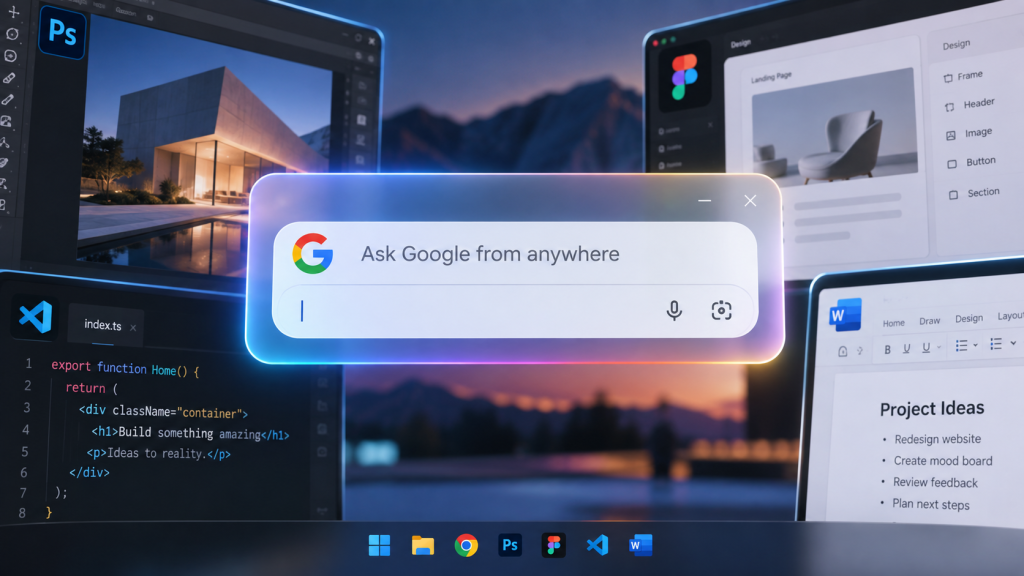
The idea is surprisingly simple. Instead of returning to Chrome every time you want Google, the feature can summon a floating search box over other Windows apps. Recent Chrome Canary testing shows it launching with Alt + Space and displaying the invitation: “Ask Google from anywhere.”
That means you could be working in Photoshop, Figma, Word or another app and bring Google to whatever you’re doing instead of bringing your work to Google.
And that’s where it gets interesting.
According to a recent hands-on look at the experiment, the interface indicates users will be able to share part or all of their screen and ask Google about what they’re looking at. Imagine highlighting something on your desktop and asking Google to identify or explain it without screenshots, uploads or another browser tab.
There’s an important catch: all of that isn’t working yet. The current experiment reportedly doesn’t show the expected Lens and AI Mode controls, so this remains a work in progress rather than a finished Chrome feature.
But Google’s direction is becoming difficult to miss. Its Gemini in Chrome and Auto Browse are already pushing Chrome beyond traditional browsing, with AI designed to handle multi-step jobs such as researching travel, scheduling appointments and filling out forms.
Project Loom could push that idea outside the browser window itself. Search and AI become a layer over your desktop rather than somewhere you specifically go.
There is no guarantee Loom will ever ship to regular Chrome users. Experiments change or disappear all the time.
But Google is still actively building this one.
What if Google Search didn’t need a browser anymore?


15 Reddit Scandals That Changed the Internet Forever
Reddit is one of the web’s biggest experiments in community design: pseudonymous users, volunteer moderators, voting systems, recommendations, and a company trying to build a business around all of it….

Web Design Schools Have a Giant YouTube University Problem — And AI Just Made It Worse
If you wanted to become a web designer 15 years ago, going to school made sense. You needed someone to teach you HTML, CSS, Photoshop, typography, UX and all the…

This Website Found More Than 5 Million Forgotten iPhone Videos… and It’s Weirdly Emotional
An old iPhone feature accidentally created a massive archive of random lives, bad camera work, dogs, vacations, and very normal afternoons. Now you can watch it one clip at a…

The Death of Apps Has Already Begun
We spent the last 15 years installing apps for everything. An app for email. An app for music. An app for banking. An app for editing photos. An app for…
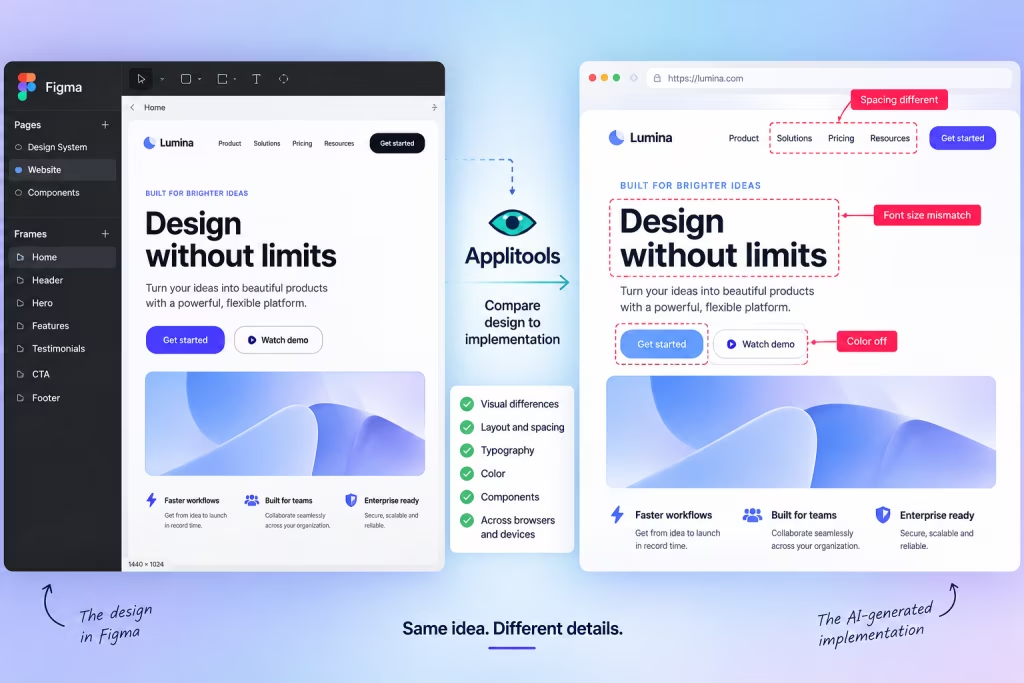
AI Can Build Your UI. Now Figma Can Tell It When It Screwed Up.
AI coding tools have become remarkably good at turning prompts into working interfaces. The awkward part comes afterward: does the thing they built actually look like the design? A new…

Cloudflare Just Gave AI Training Bots the Middle Finger
If you run a website, you probably want Google to crawl it. You probably don’t want every AI company on the planet helping itself to your content to train its models. Until…