1
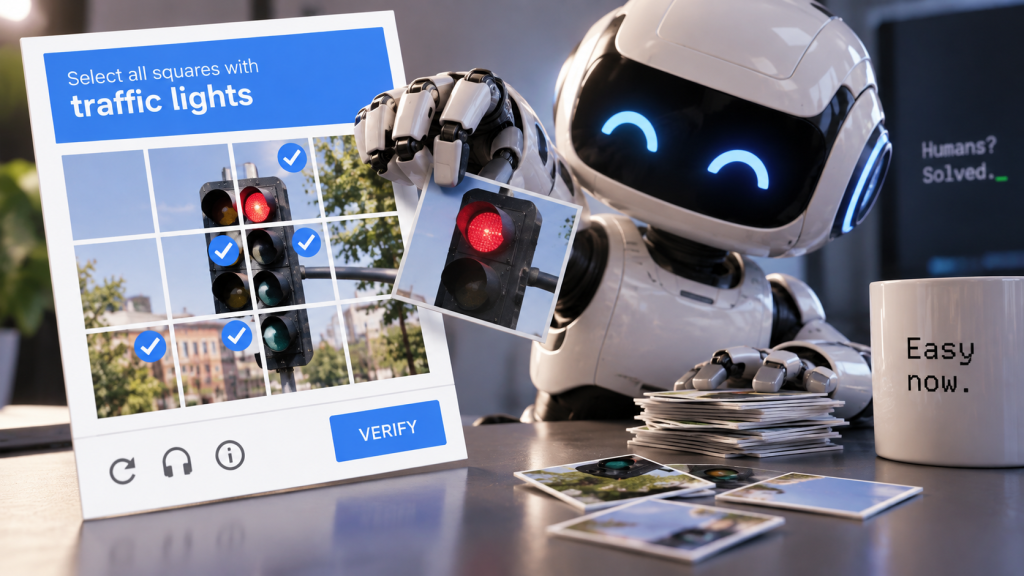
For years, the internet has made us click traffic lights, identify motorcycles and decipher mangled letters to prove one simple thing: we’re not robots.
There’s just one problem.
The robots are getting pretty good at it.
AI is making traditional CAPTCHA puzzles increasingly ineffective, according to a new Wall Street Journal report. Modern AI systems can recognize images and solve visual challenges that were once difficult for automated software, turning one of the web’s most familiar security rituals into an increasingly strange arms race.
And the irony is difficult to beat: we created puzzles that were supposed to separate humans from machines, then spent years building machines that became better at understanding exactly those kinds of images.
The CAPTCHA Is Already Changing
That doesn’t mean you’ll never again be asked to find three blurry bicycles. Visible CAPTCHAs are still widely used, particularly when a website considers a visitor suspicious. But increasingly, the real bot detection is happening somewhere you can’t see.
Google’s own reCAPTCHA v3 doesn’t require users to solve a puzzle at all. Instead, it analyzes traffic and returns a risk score that websites can use to decide whether an interaction looks legitimate.
Cloudflare has gone even further with Turnstile, which it explicitly describes as a “smart CAPTCHA alternative.” It can examine browser characteristics and other signals through small background challenges, often without asking the visitor to do anything. Cloudflare even provides instructions for websites that want to migrate from reCAPTCHA to Turnstile.
More recently, Cloudflare introduced another system called Precursor, designed to analyze behavior throughout a browsing session rather than relying on a single checkpoint.
In other words, the question is slowly changing from “Can you prove you’re human?” to something closer to “Does what you’re doing look trustworthy?”
But Don’t Celebrate Yet
There’s a catch. The disappearance of those irritating puzzles doesn’t mean the bot problem is disappearing with them. Quite the opposite: increasingly capable AI agents make distinguishing legitimate visitors, useful automated agents and malicious bots much harder.
That could make the next generation of CAPTCHA effectively invisible. Your browser, device characteristics, network reputation and behavior can provide signals that determine whether you’re allowed through—without you ever seeing nine little squares containing a suspicious number of crosswalks.
For web designers, that’s potentially good news. Few UX patterns have interrupted a perfectly innocent form submission quite like suddenly being handed an unpaid shift as Google’s traffic-light inspector.
The CAPTCHA probably isn’t dead yet.
But the version we’ve spent years swearing at may finally be on its way out.
And somewhat beautifully, the robots it was designed to stop may be helping to kill it.

AI Was Coming for Your Design Job. Turns Out, It Might Just Be the Intern
For three years, web designers have been told AI is coming for their jobs. Turns out, it may have been coming for the internship. That’s the surprisingly cheerful message from design…

30 Google Secrets You’ll Wish You Knew Years Ago
We all use Google dozens of times a day to settle random arguments, look up recipes, or figure out what that weird symptom means. But most of us are only…
15 Reddit Scandals That Changed the Internet Forever
Reddit is one of the web’s biggest experiments in community design: pseudonymous users, volunteer moderators, voting systems, recommendations, and a company trying to build a business around all of it….

Web Design Schools Have a Giant YouTube University Problem — And AI Just Made It Worse
If you wanted to become a web designer 15 years ago, going to school made sense. You needed someone to teach you HTML, CSS, Photoshop, typography, UX and all the…
This Website Found More Than 5 Million Forgotten iPhone Videos… and It’s Weirdly Emotional
An old iPhone feature accidentally created a massive archive of random lives, bad camera work, dogs, vacations, and very normal afternoons. Now you can watch it one clip at a…

The Death of Apps Has Already Begun
We spent the last 15 years installing apps for everything. An app for email. An app for music. An app for banking. An app for editing photos. An app for…