
1
If you’ve ever sat down at 11:00 PM to check a single notification and snapped back to reality at 2:00 AM staring at a stranger’s video of a house renovation, you didn’t just lose three hours of sleep. You were mugged by the single worst architectural decision in the history of web design: the infinite scroll.
For nearly two decades, the tech industry worshiped Aza Raskin’s 2006 invention like holy scripture. We told ourselves that eliminating friction, killing the back button, and constantly fetching fresh DOM nodes was peak user experience. That was a lie. It wasn’t user experience; it was behavioral exploitation dressed up as clean front-end engineering.
Now, the bill has finally come due. Inside a courthouse, state attorneys general are tearing into Meta in a federal trial over Instagram and Facebook, calling the endless feed a predatory weapon explicitly engineered to break human willpower. The EU is slapping similar charges under the Digital Services Act, and a California jury already hit tech giants with millions in damages over addictive design mechanics.
We need to stop pretending this was an accident. Web designers didn’t accidentally code an addictive loop. We intentionally destroyed every structural stopping cue from the screen experience because endless feeds drove ad impressions through the roof.
Web 1.0 was built on books, chapters, and footers—structural boundary lines that forced the browser to stop, giving the user a pause-and-evaluate beat to close the tab. Infinite scroll shoved those boundaries into a woodchipper and replaced them with the exact variable-reward mechanics of a Las Vegas slot machine. Scroll past three boring ads, hit one high-value post, and your brain instantly learns to pull the lever again.
Beyond the predatory psychology, infinite scroll is just plain garbage software design. It turns the <footer> into a fleeing target that runs away from the cursor when you try to click a support link. It bloats the document tree with thousands of unrendered nodes until mobile browsers suffer frame-rate crashes. It vaporizes viewport memory: tap a link, hit the back button, and state management chokes, dumping you back at page one like a punishment.
We traded fundamental front-end integrity for brute-force engagement.
The era of engagement-at-all-costs web design is dying in open court. We don’t need a judge to dictate our CSS, but as web professionals, we have an ethical obligation to kill this pattern ourselves. Bring back explicit “Load More” break points, build hard “You’re All Caught Up” anchors, and embrace background-fetched pagination with clean pushStateURLs.
The open web was never meant to feel like a bottomless pit. It’s time we stop building software that treats human attention like an infinite resource to be mined.


Web Designers Love Dark Mode Toggles. Users Might Not Care.
Somewhere along the way, the little sun-and-moon icon became practically mandatory. Portfolio? Dark mode toggle. Documentation site? Dark mode toggle. SaaS landing page? Naturally, a dark mode toggle sitting proudly…

How the Prompt Box is Swallowing Website Interfaces Whole
I had a moment the other day where I stared at a software dashboard and realized I was completely exhausted. I was trying to run a relatively simple financial report….

Nobody Wants Your Damn App
I just wanted to check your website. I didn’t want to download 200MB of software. I didn’t want another icon on my home screen. I definitely didn’t want to create…

Chrome Can Now Measure Exactly How Obnoxious Your Website’s Ads Are
We’ve all opened that website: three ads before you reach the first paragraph, a giant sticky banner and a video desperately trying to follow you down the page. Now Chrome can actually measure…

Apple’s Foldable iPhone Has a Left-Handed Problem
Apple’s new iPhone Duo moves some familiar controls from the top and bottom of the screen into a vertical bar along the side when its larger inner display is used…
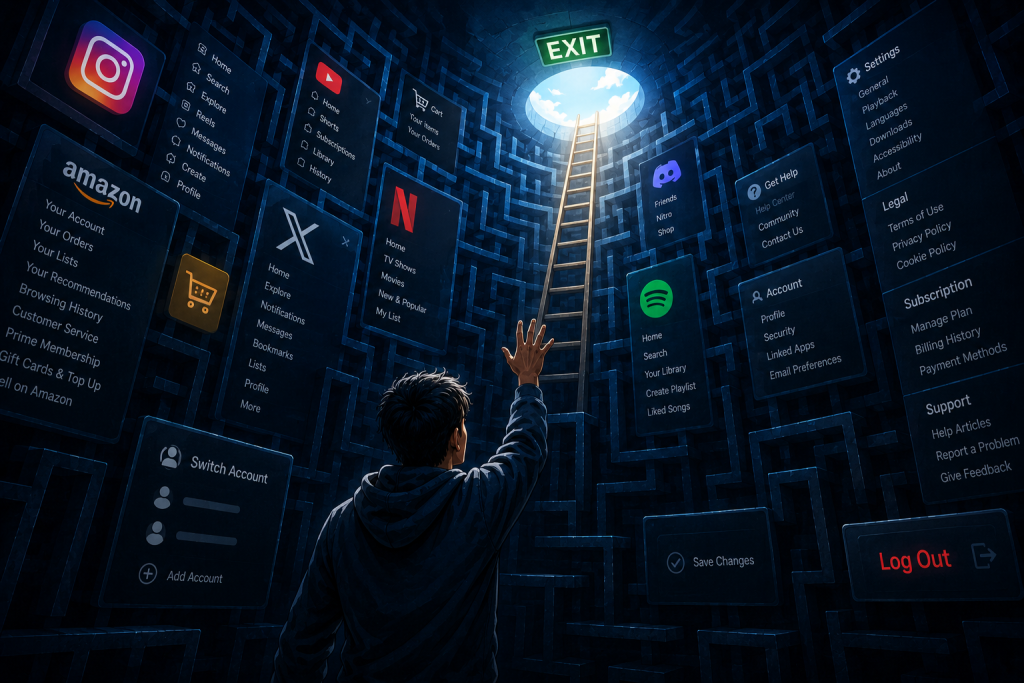
Why Tech Companies Hid the “Log Out” Button (And How to Win It Back)
Try to log out of Netflix on your TV right now. Go ahead. I’ll wait. If you’re like most people, you’ll end up aggressively mashing the left arrow key, accidentally…